Building the Blog This Post Lives On
From air traffic control to AI engineering — who I am, why I built my own development blog instead of using a template, and the problems I solved getting it live.
I’m Dwight Thompson, a retired air traffic controller from Fayetteville, North Carolina, now studying artificial intelligence full time. This blog is where I’ll document my projects, starting with COS359. Fittingly, the first thing I built for this class was the blog itself.
From the tower to tech
My career started in air traffic control in the Marine Corps. From there I moved to the FAA and retired in 2020 as an ATC operations supervisor. Alongside that career I followed a few passions. I opened an independent car dealership in 2019 as a solo owner-operator, ran it part time while I was still controlling, then scaled it after I retired, until 2023, when I decided to lean fully into tech.
A lifelong learner
I’ve never stopped taking classes. From 2000 to 2006 I took general studies at satellite campuses. In 2007 I completed an autobody and restoration program, and from 2007 to 2009 an automotive technologies program, both out of personal passion. In 2011 I started the Small Business Entrepreneur program at the University of Phoenix, taking upper-level core classes at night while working full time as a controller. I didn’t finish that degree; I took it for the knowledge. Now I’m enrolled in Full Sail University’s Bachelor of Science in Computer Science with a concentration in artificial intelligence. I started in late 2024 and expect to graduate in April 2027.
Why AI, and why now
I grew up during the last tech revolution. I remember life before the internet and cell phones, when a home PC wasn’t common at all. I turned 18 in 2000, just as the internet started to take off. I see AI as the next revolution: full of bubbles, but also real opportunity for growth within humanity, and I want to be part of it. I was an early adopter, getting access to OpenAI’s API by invitation in 2019 and taking Google and Udemy courses on AI. When I saw what it could become, I decided to pursue it full time. Full Sail was the only structured school I found advertising a bachelor’s degree in AI, so that’s where I went.
The problem: a blog I’d actually want to keep
This assignment asked for a development blog, and recommended platforms like WordPress or Weebly. That raised a real problem. I didn’t want another login and another app I wouldn’t be happy with. I also needed to seriously start a professional developer website where I could showcase my projects and skills, and I didn’t have much web development experience. A blog on a generic platform would check the box but wouldn’t move me forward.
The solution: building my own professional dev site
So I built the foundation of my own site, heismrthompson.com, and made the blog part of it. The blog isn’t tied to one class: every project gets its own blog, milestones and documentation, so I can keep adding to it as I work on COS359 and everything after.
I wanted the site to feel like a desktop application on a computer, and like an app on a phone, not a standard drag-and-drop website. There are no long, overwhelming scrolling pages, and the headers stay fixed. The navigation is built around loops. That’s a simple visual style, and it’s also a nod to my current focus: agentic workflows that run in loops, autonomous development workflows, and my research into refinement and reflection loops.
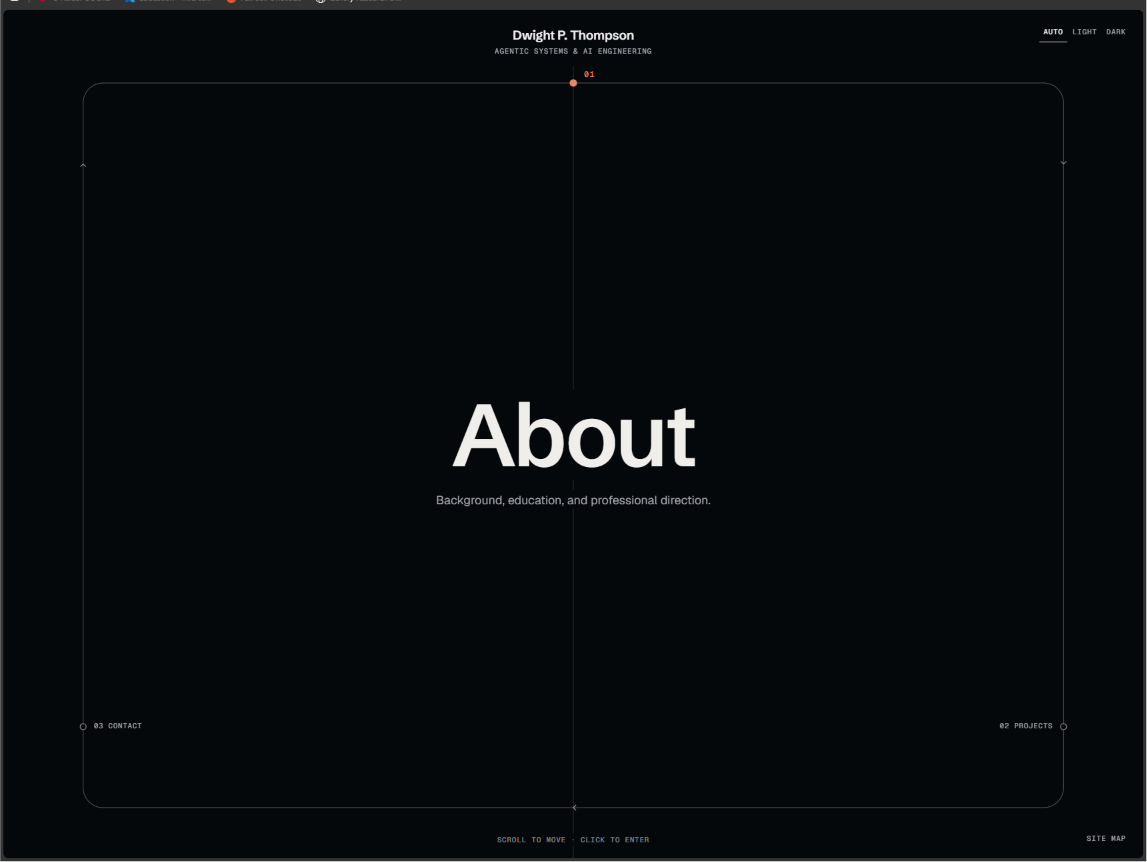
The home page is one loop. Scrolling turns it to the next section; clicking the title goes inside.
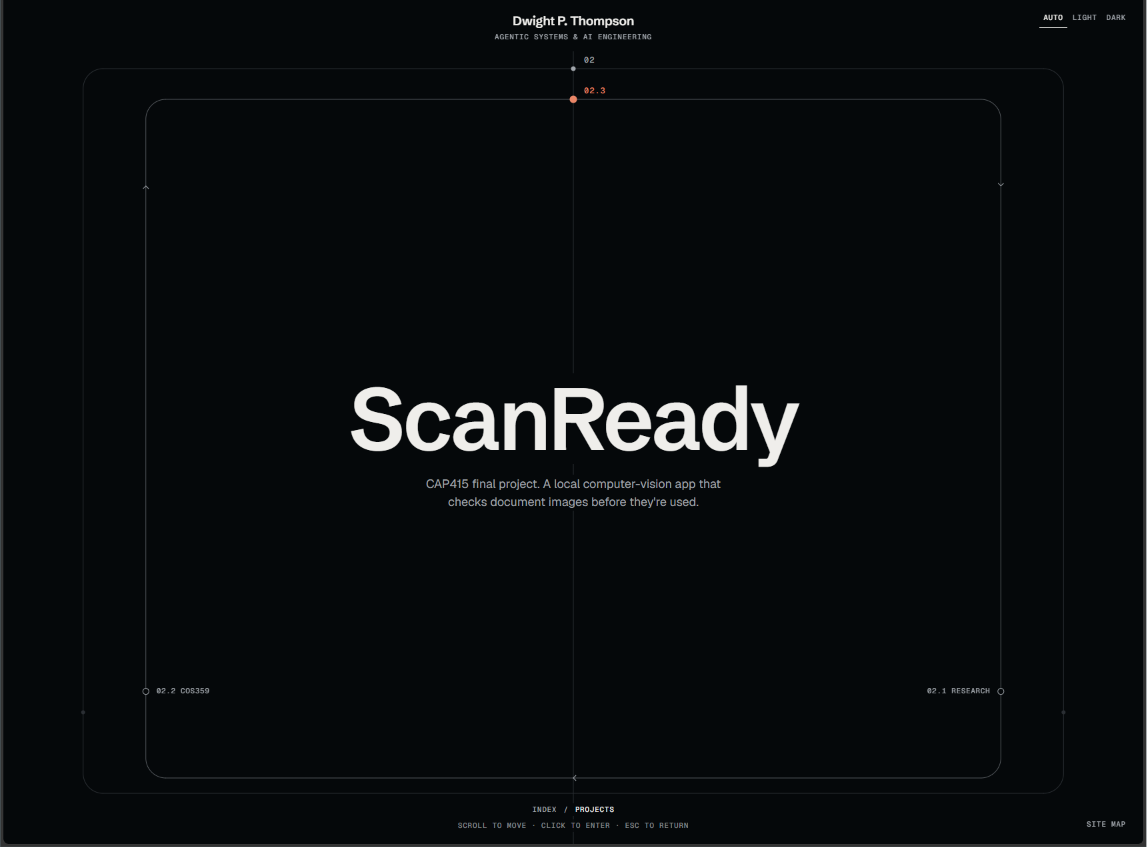
Each level nests inside the last. Here, Projects holds Research, COS359 and ScanReady.
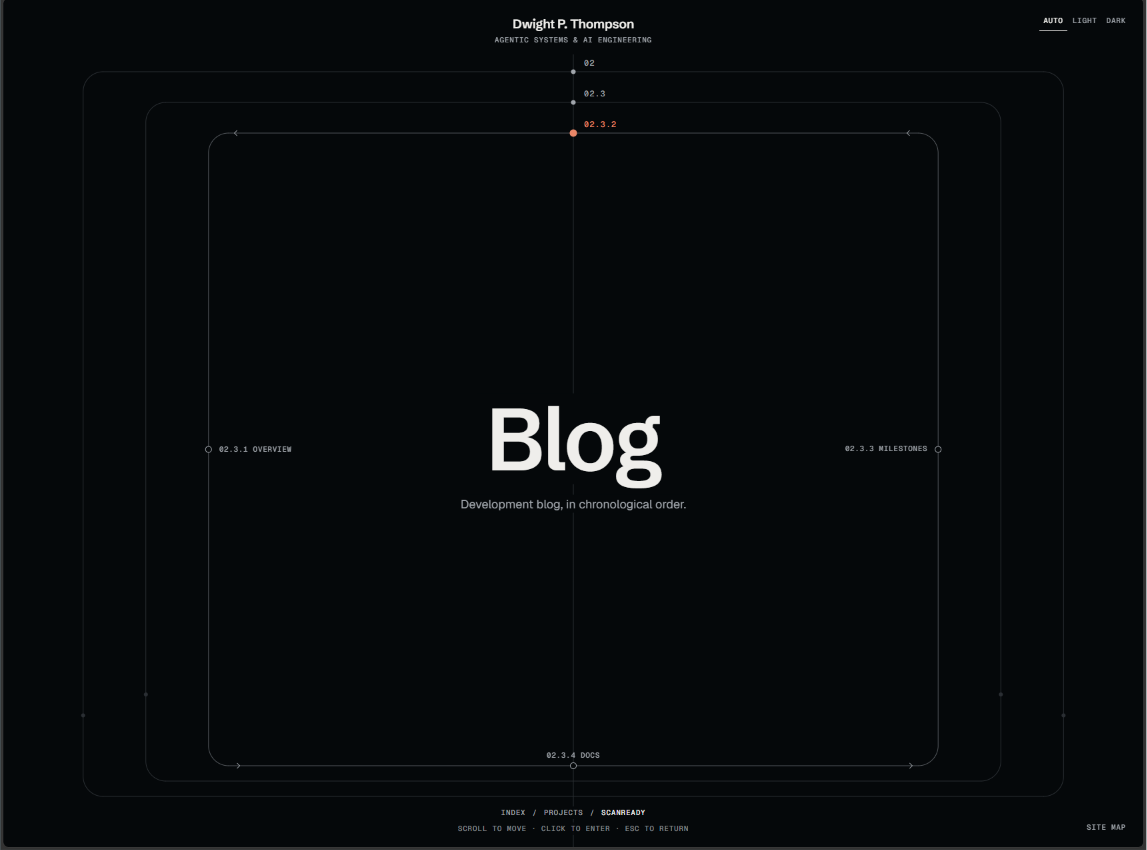
Every project gets the same four sections.
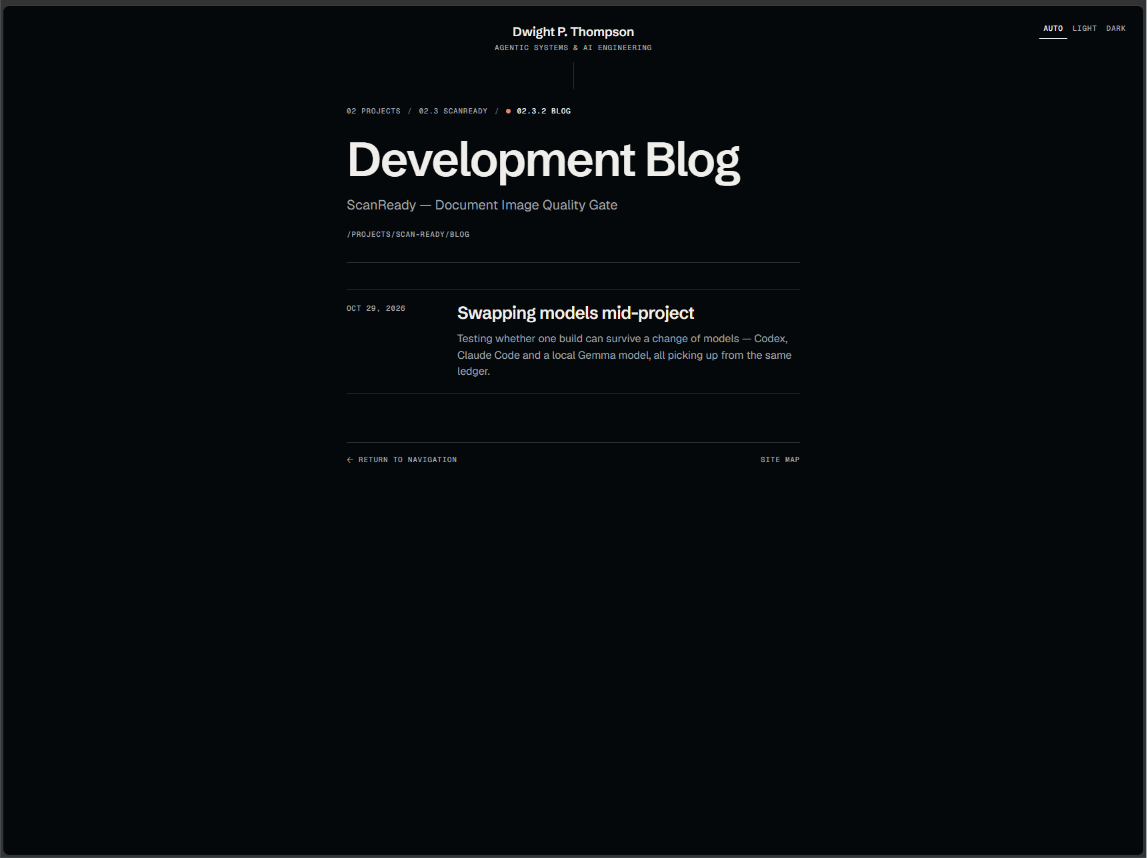
The blog itself is a regular reading page, with each post dated and listed in order.
Problems I solved along the way
Visitors didn’t know what to click. When my family tried the site, they liked it but weren’t sure what to do. My brother, on his phone, tapped the “Swipe to move · Tap to enter” hint at the bottom of the screen, and nothing happened. The hint was set to ignore taps. I kept its look and position but made it tappable, so it opens whatever is in the center of the loop, the same as tapping the title.
The arrows only pointed one way. Small arrows on the loop show its direction, but they always pointed clockwise, even when scrolling turned the loop the other way. Now they flip with a quick half-turn to point the way the loop last moved, and stay that way until the next move.
The address without “www” didn’t work. www.heismrthompson.com loaded the site, but heismrthompson.com showed a registrar placeholder page. The domain’s root still pointed to the registrar’s default page. Once I pointed it to the site, both addresses worked.
I tested each fix visually on my PC and my phone, and ran the site’s unit tests before every push.
Goals
In COS359, Project & Portfolio V, I want real-world experience. I’ll pitch my own project idea like everyone in the class, and I’m especially interested in the Echelon Fit opportunity. Echelon Fit partners with Full Sail so student teams can work with its development team on features that go into production on its fitness smart equipment. Beyond this class, my direction is agentic development: autonomous agentic workflows and the operating layers that run them.